Residential Asbestos Testing in Broward County
Residential asbestos testing means collecting samples from suspect materials — popcorn ceilings, floor tile, insulation — and sending them to an accredited lab for PLM analysis under EPA Method 600/R-93/116. In Broward County, a single-sample test typically runs $250 to $700, with results back in 2 to 3 business days.
Starting at $250
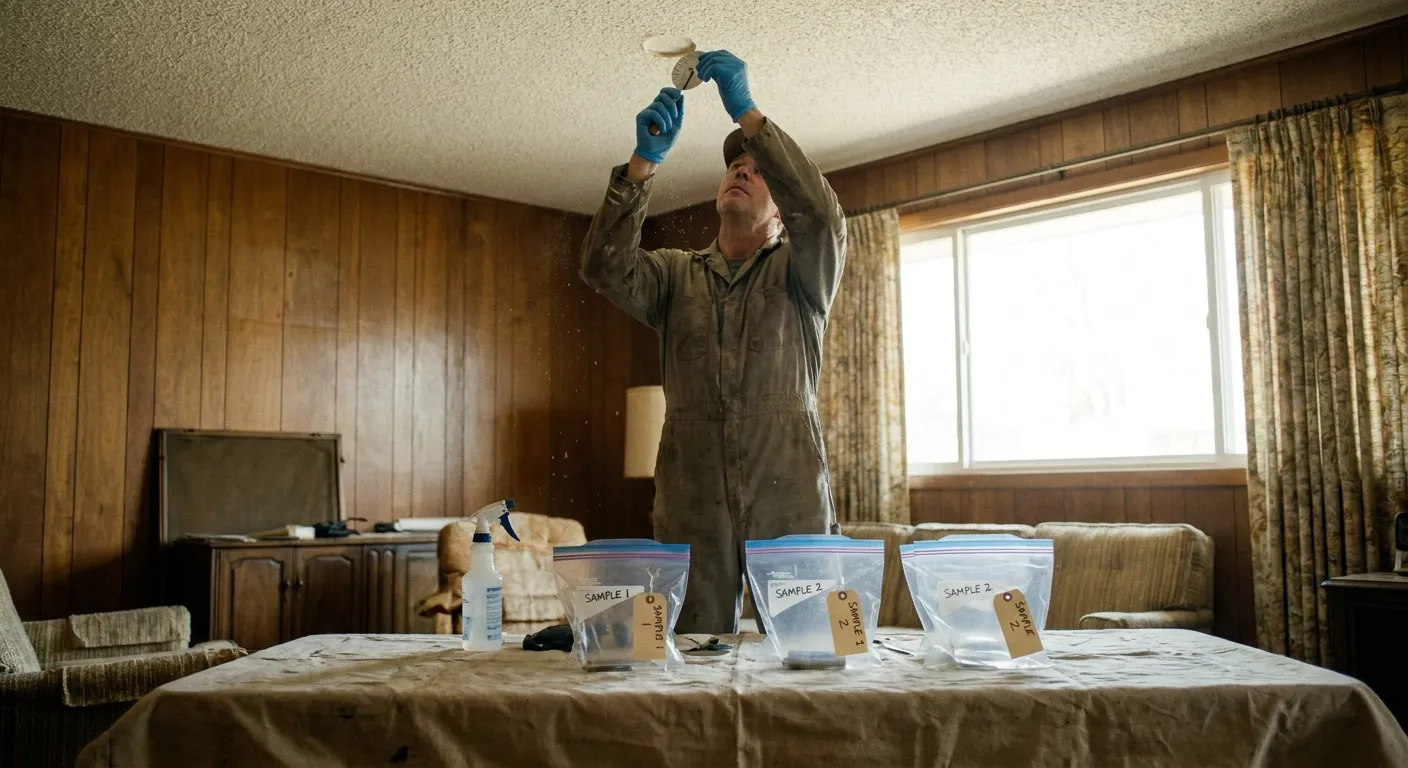
You found a stained ceiling tile, a cracked square of old floor tile, or a wrapped pipe in a Broward County home built before 1980, and now you’re deciding whether it’s safe to touch, sand, or tear out. Looking at it won’t tell you anything reliable — asbestos-containing material looks like ordinary building material until it’s examined under a microscope. A lab result is what turns that guess into an answer you can act on before you schedule a renovation, pull a permit, or start a repair.
What does residential asbestos testing include?
Residential asbestos testing is a two-part process: an on-site inspection and sample collection by a trained technician, followed by laboratory analysis of each sample under Polarized Light Microscopy (PLM), the method described in EPA Method 600/R-93/116. On a typical Broward County home, collection takes about 30 to 60 minutes — the technician identifies suspect materials, takes a small sample from each one, seals it, and logs its location before the batch goes to the lab. Because asbestos fibers are microscopic, the EPA is clear that the material cannot be confirmed by sight alone; lab analysis is the only reliable answer.
A standard residential visit follows roughly the same sequence in most homes we test:
- Walk-through to flag suspect materials based on age, location, and condition
- Sample collection from each material type, sealed and labeled on site
- Chain-of-custody transfer to an NVLAP- or AIHA-accredited lab
- PLM analysis and a written report identifying asbestos content by sample
OSHA has stated there is no established safe level of asbestos exposure, which is exactly why guessing based on a material’s age or appearance isn’t good enough. As our licensed inspectors put it, “we collect only what the lab needs to give you a defensible answer, not a bigger invoice.” If your situation is more about confirming whether a full inspection is warranted before any sampling happens, our asbestos inspection page walks through that first step separately.
What materials do we test in a Broward home?
In Broward County homes, we most often sample popcorn or textured ceilings, 9-by-9-inch vinyl floor tile and its black mastic adhesive, joint compound, and pipe or duct insulation, because these were the materials most commonly manufactured with asbestos into the early 1980s, according to the EPA. Spray-applied popcorn texture was specifically banned for new application in 1973, but plenty of ceilings installed before that ban — and some later remodels using older stock — are still up today, so age alone doesn’t rule a home in or out. Each suspect material gets its own sample and its own lab result, since a single home can turn up both asbestos-containing and asbestos-free materials in the same room.
| Material | Where it’s usually found | Why we test it |
|---|---|---|
| Popcorn / textured ceiling | Ceilings in pre-1980s homes | Spray-applied surfacing was banned for new use in 1973; older ceilings are frequently untested |
| 9x9 vinyl floor tile & mastic | Kitchens, bathrooms, utility rooms | A common asbestos-containing tile size manufactured before the early 1980s |
| Joint compound | Drywall seams, textured walls | Historically reinforced with asbestos fiber for strength and crack resistance |
| Pipe & duct insulation | Attics, crawlspaces, utility closets | Wrapped insulation was a standard asbestos application in older construction |
If a textured ceiling is the only material in question, our dedicated popcorn ceiling asbestos testing page covers what a single-material sample costs on its own, separate from a whole-house test.
How much does it cost and how long does it take?
A single-sample residential asbestos test in South Florida typically runs $250 to $700, with the price driven by how many materials and locations need separate samples rather than by time on site — one Broward homeowner we worked with paid roughly $400 for eight samples across a full renovation. Lab turnaround is standard 2 to 3 business days once samples arrive, and many labs offer a 24-hour or same-day rush for an added fee. On-site collection itself only takes about 30 to 60 minutes for a typical single-family home, so most of the wait is lab processing, not the visit itself.
A few things move the price and timeline within that range:
- Number of distinct materials sampled (each gets its own lab fee)
- Whether you need standard turnaround or a paid rush option
- Multi-sample or whole-house surveys, which price by sample count or square footage rather than a flat single-sample fee
For a fuller breakdown by sample count and material type, see our asbestos testing cost guide. If you’re ready to move forward, request a free quote and we’ll confirm the sample count and turnaround for your address before anyone shows up.
Why use an independent testing company instead of a removal contractor?
An independent testing company has no financial stake in what the lab finds, because we don’t perform abatement or removal — our business is an accurate answer, not the work generated by a positive result. That separation matters in Broward County, where a contractor that both tests and removes has a built-in incentive to find asbestos on every job it looks at. Our licensed inspectors keep the process simple: collect samples, send them to an accredited lab, and report exactly what comes back, whether that means asbestos-containing material or a clean result.
Testing also ties into Broward County’s paperwork. Residential buildings with four or fewer dwelling units are exempt from most federal and county asbestos notification rules beyond the county’s online Statement of Responsibilities Regarding Asbestos (SRRA) submittal through ePermits, according to the Broward County Asbestos Program at broward.org, though larger renovation or demolition projects can trigger additional requirements. A written PLM result still gives you documentation, whether you’re planning a DIY repair, hiring a contractor, or settling a question a home inspector raised.
To see our complete range of Broward County testing and survey services, visit Broward Asbestos Testing’s home page.
Frequently asked questions
How much does asbestos testing cost in Broward County?
Most single-sample asbestos tests in Broward County run about $250–$700, depending on how many materials are sampled and lab turnaround. A basic one- or two-sample popcorn-ceiling test sits at the low end; a whole-home or pre-renovation survey with multiple samples costs more. You get a written lab report either way.
How long does asbestos testing take?
On-site sample collection usually takes 30–60 minutes for a typical home. The samples then go to an accredited lab, where standard turnaround is 2–3 business days; many labs offer 24-hour or same-day rush for an added fee. You get a written report with each material's result once analysis is complete.
How do inspectors test for asbestos?
A licensed inspector wets and carefully cuts small pieces from each suspect material — popcorn ceiling, floor tile, mastic, joint compound, insulation — seals them in labeled bags, and sends them to an accredited lab. The lab uses polarized light microscopy (PLM) for bulk materials, or air sampling with TEM when airborne fibers are the concern.
Will insurance pay for asbestos testing?
Usually not for routine testing. Homeowners' policies rarely cover voluntary asbestos inspections, and testing before a remodel is normally an out-of-pocket cost. Insurance may come into play only when asbestos is disturbed by a covered event, such as a burst pipe or storm damage that spreads material — check your specific policy.
Is it worth testing for asbestos?
If you are renovating, demolishing, or buying a pre-1980s home, yes. A $250–$700 test is far cheaper than the cost of accidentally releasing fibers — which can mean an emergency cleanup, a stalled permit, or a health risk to your family. Testing turns a guess into a documented answer before any dust is made.
Related services
- Asbestos Inspection Services in Broward CountyAn asbestos inspection is an on-site walkthrough, sampling, and lab analysis of suspect …
- Popcorn Ceiling Asbestos TestingPopcorn ceiling asbestos testing means collecting a sample from your textured ceiling an…
- Asbestos Survey Services in Broward CountyAn asbestos survey is a whole-structure inspection — not a single test — that samples ev…